You might already be investing in Google Ads, getting website visits and receiving phone calls. But are those inquiries turning into the patients your practice actually wants, like an Invisalign case, an implant or a full smile makeover?
We recently spoke with a dental practice owner in Chicago who shared the same concern. The practice offers Invisalign, dental implants, crowns, veneers and smile makeovers, yet consistent, quality patient inquiries were hard to come by. With several practices competing in the same area, simply running ads wasn’t enough.
Don’t worry, we’ve done the homework for you. In this guide, we break down how InstaServ approaches dental lead generation on Google and Meta, treatment by treatment, so you can see what it takes to turn ad spend into booked patients.
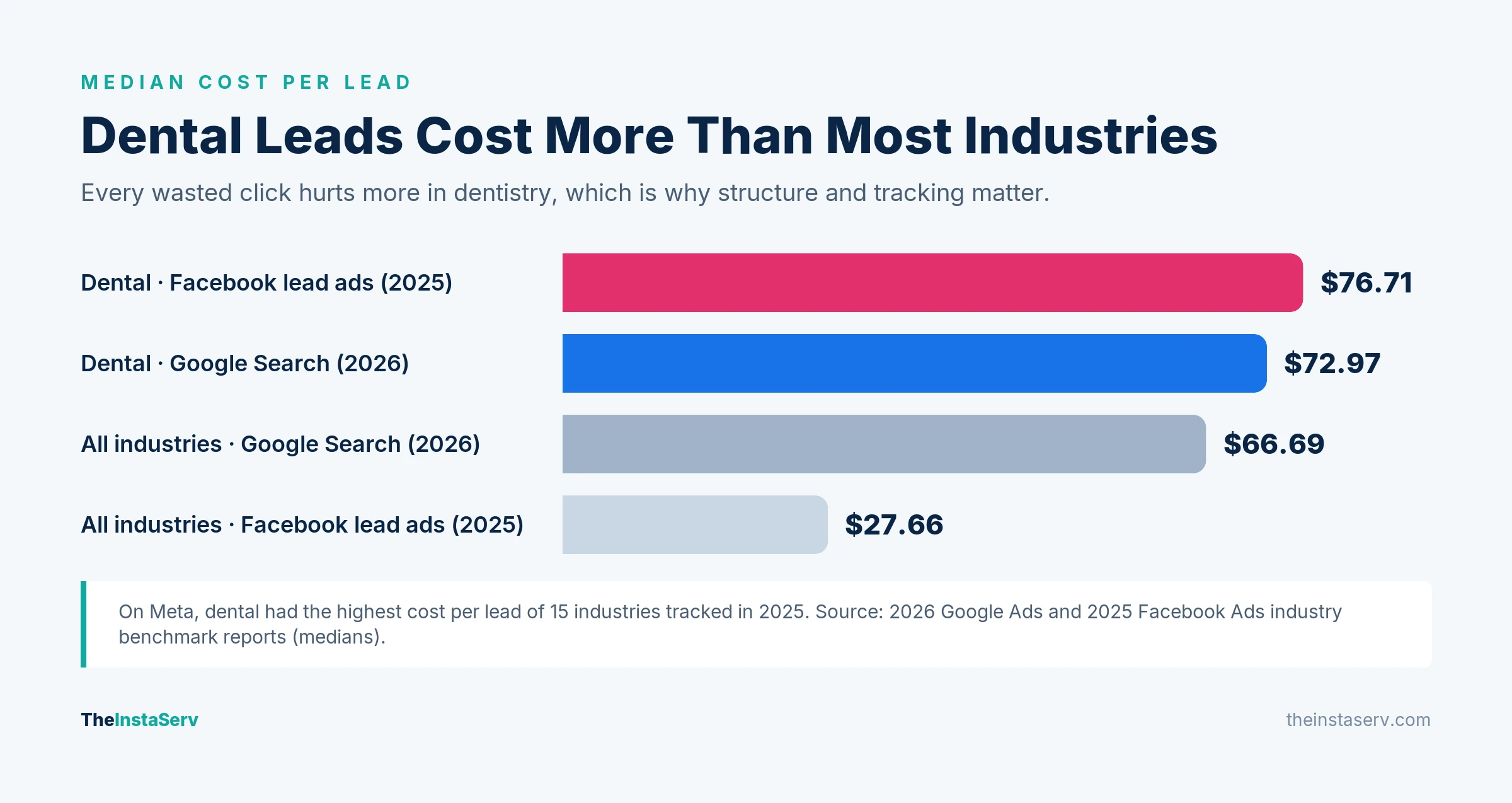
Dental is one of the most expensive and competitive categories in online advertising. Industry benchmarks for 2026 put the median dental Google Ads click at around $8.00, with a median cost per lead of roughly $73. On Meta, dental lead campaigns had the highest cost per lead of 15 industries tracked in 2025, at about $77 per lead.
That means every mistake costs more. Here is where we usually see practices losing money:
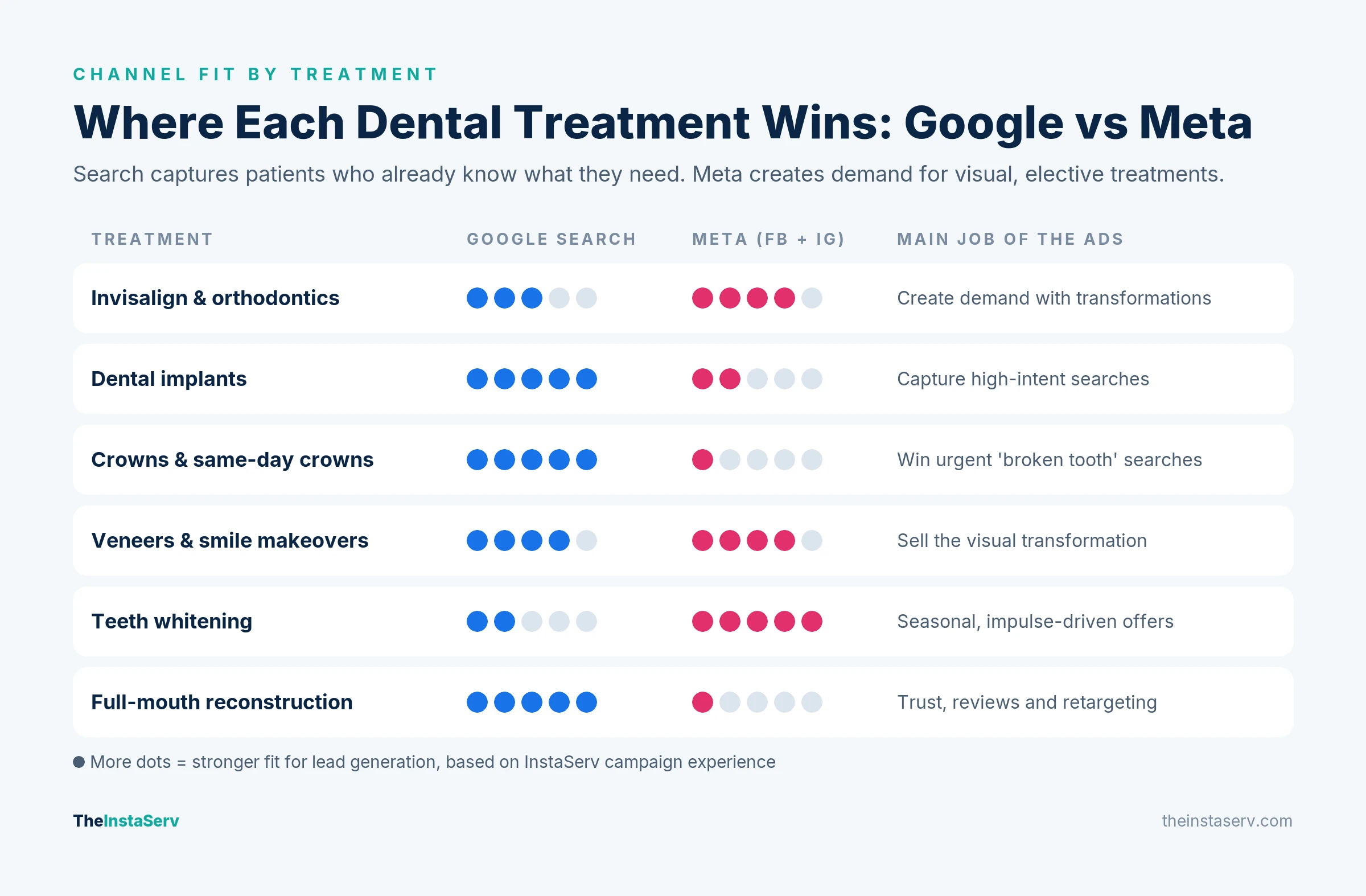
Not every dental patient is worth the same to a practice. On our calls, owners consistently tell us they want more patients for high-ticket, elective and restorative treatments. Each one needs its own strategy.
| Treatment | Best channel | How patients search | Campaign angle |
|---|---|---|---|
| Invisalign and orthodontics | Meta first, Google support | Browsing, comparing options | Before-and-after stories, monthly payment offers |
| Dental implants | Google first | Researching with clear intent | Cost transparency, consultation booking |
| Crowns and bridges | Urgent, problem-driven | Same-day or next-day availability | |
| Veneers and smile makeovers | Meta and Google | Aspirational, visual | Smile transformations, free consultations |
| Teeth whitening | Meta | Impulse and event-driven | Seasonal offers, quick results |
| Full-mouth reconstruction | Long research cycle | Expertise, trust, financing |
1. Invisalign and Orthodontics
Clear aligners are one of the best-performing treatments on Meta. Many people don’t realise they want straighter teeth until they see a relatable before-and-after. That is demand you can create with the right creative.
How we approach it:
2. Dental Implants
Implant patients do their homework. They compare prices, read reviews and often take weeks to decide. That makes Google Search the primary channel, because you meet them at the exact moment they search.
How we approach it:
3. Crowns and Bridges (Including Same-Day Crowns)
This is where a practice’s unique advantages become powerful ad copy. If your practice can deliver a well-fitting crown the same day, or within 24 hours, thanks to an on-site or nearby lab, make it the headline. For a patient who just broke a tooth, that is the whole decision.
How we approach it:
4. Veneers and Smile Makeovers
Veneers, porcelain and lithium disilicate restorations and complete smile makeovers are visual, emotional purchases. Patients want to picture their new smile before they book.
How we approach it:
5. Teeth Whitening
Whitening is an easy entry point. It is lower ticket, but it brings new patients into the practice who often return for bigger treatments.
How we approach it:
6. Full-Mouth Reconstruction
We’ll be honest here. In our experience, Meta ads for full-mouth reconstruction rarely bring quality leads. These patients need trust, expertise and time. Google Search, strong reviews and educational content do the heavy lifting, while Meta works best for retargeting people who have already shown interest.
Big cities like Chicago and New York are among the toughest dental advertising markets in the US. When dozens of practices sit within a few blocks, sometimes in the same building, you are not just competing on Google. You are competing for the same lobby.
Competition is real in every industry, but it is not a reason to stop advertising. It is a reason to advertise smarter. Here is how we help practices stand out:
This is one of the first questions every practice owner asks us. The honest answer depends on your city, your treatments and your goals, but here are the guidelines we share.
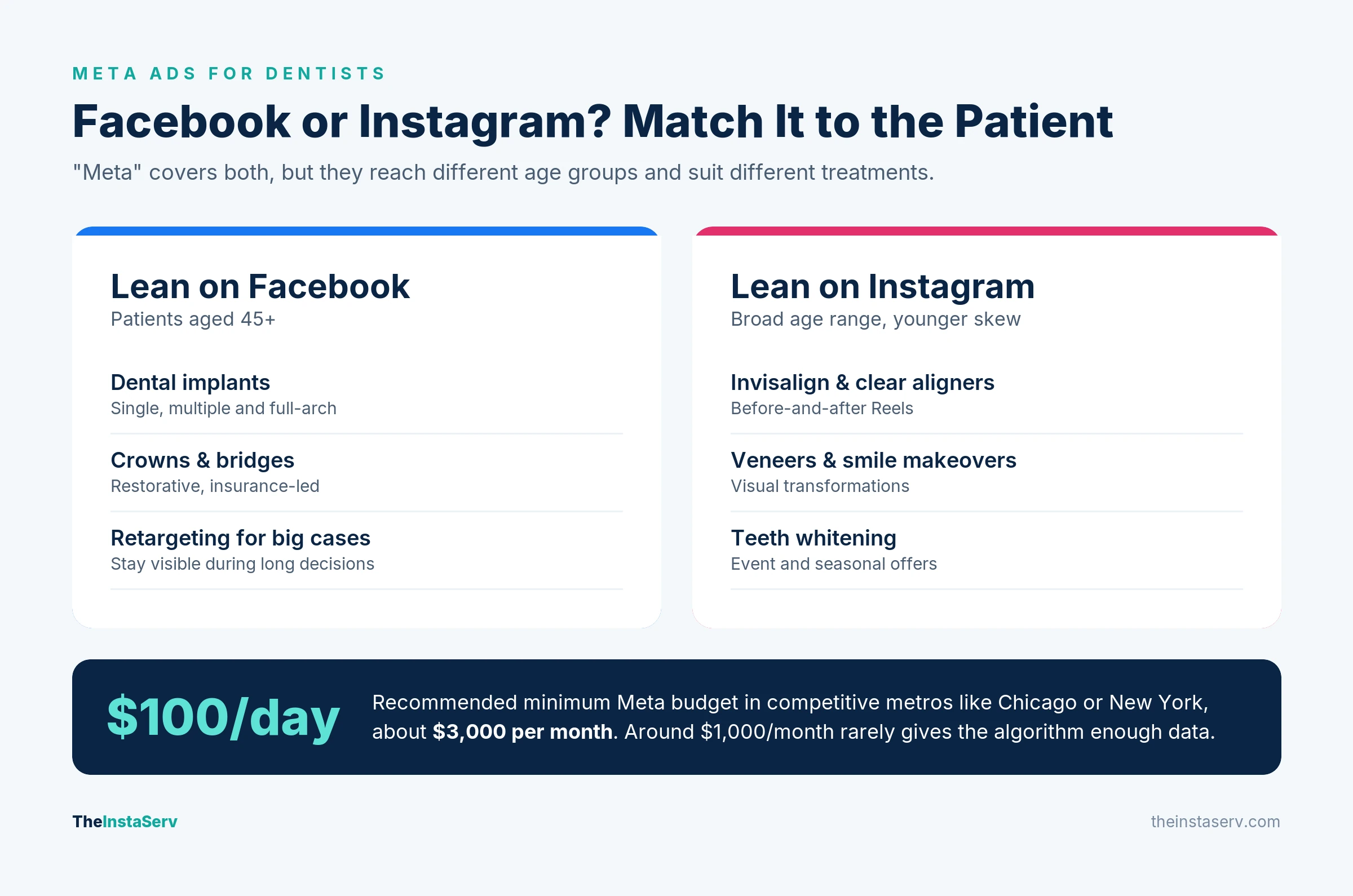
Meta (Facebook and Instagram): For competitive metro areas, we recommend a minimum of $100 per day, or around $3,000 per month, across Meta. A $1,000 monthly budget usually isn’t enough for the algorithm to find and learn from the right patients. Smaller, less competitive markets can sometimes start lower.
Google Ads: Many practices we speak with spend between $3,000 and $5,000 per month on Google. At that level, you should be seeing results. If you aren’t, it is usually a structure, targeting or tracking problem, not a budget problem.
Facebook or Instagram? It Depends on Who You Want to Reach
People say “Meta” now for a reason. Facebook and Instagram reach different audiences:
A lead is not a patient. A practice owner can’t be expected to tell us whether every single call was qualified. That is why tracking comes before scaling.
Before any campaign goes live, we make sure:
When the algorithm learns from real bookings instead of every ring of the phone, lead quality improves.
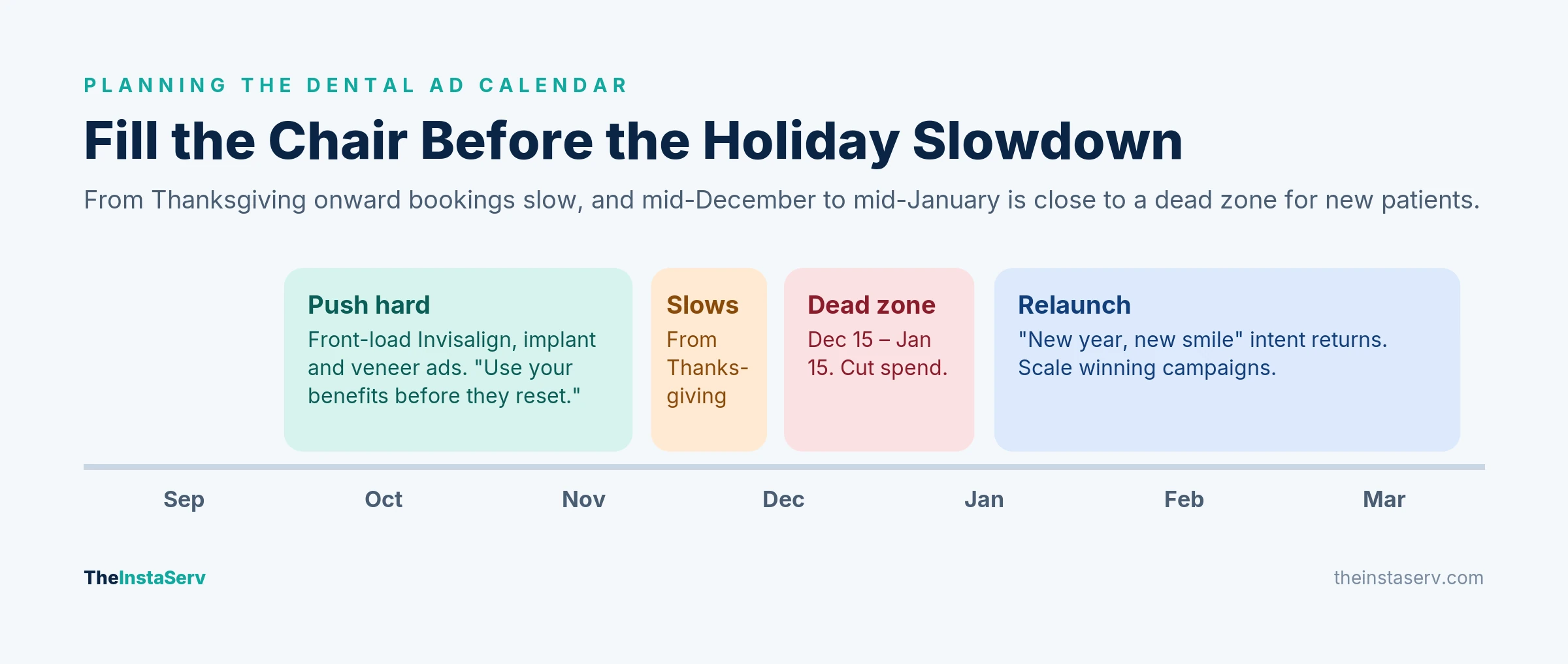
Dental demand isn’t flat across the year. Once Thanksgiving and Black Friday arrive, bookings slow, and from around mid-December to mid-January, many practices see very little new-patient activity.
We plan around this by:
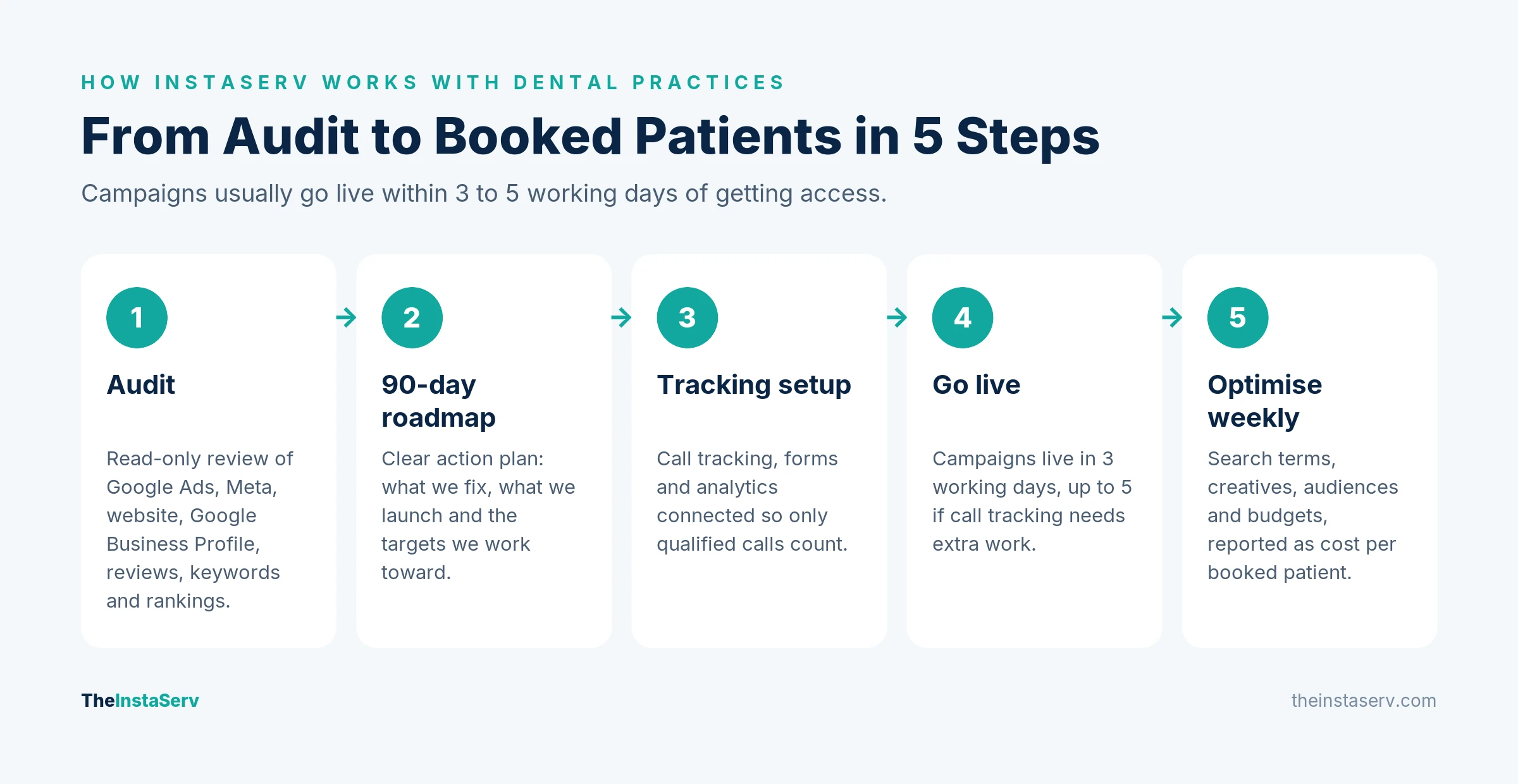
We keep our process simple and transparent.
Dental lead generation in 2026 isn’t about spending more. It’s about spending right. The practices that win treat Invisalign, implants, crowns, veneers and whitening as separate campaigns, track qualified calls instead of every ring, use the right Meta platform for the right age group, and plan around seasonal dips.
If your practice is spending on Google or Meta and the high-value cases still aren’t coming in, the problem is fixable. And if you’ve had results before, you already have a benchmark to build on. For a deeper look at search campaigns, read our guide on Google Ads for dental practices.
Partner with InstaServ and let’s turn your ad spend into booked patients.
Frequently Asked Questions
Dental is one of the most expensive Google Ads categories, with a median click cost of around $8 in 2026. Most practices in competitive cities need at least $3,000 to $5,000 per month to generate consistent leads for high-value treatments.
For competitive cities, we recommend at least $100 per day, or about $3,000 per month, across Facebook and Instagram. Lower budgets usually don’t give the algorithm enough data to find quality patients.
Invisalign, teeth whitening and veneers usually perform well on Meta because demand can be created with visual content. Implants, crowns, emergency treatment and full-mouth reconstruction perform better on Google, where patients are already searching with intent.

After a quick audit and access to your website, ad accounts and analytics, campaigns usually go live within 3 working days, or up to 5 if call tracking needs to be set up.
We connect call tracking, form tracking and analytics to your ad accounts, separate qualified calls from wrong numbers and price shoppers, and optimise campaigns toward booked appointments instead of raw clicks or calls.
CUSTOM
Services:
SME
Services:
STARTUP PLAN
Services: