Official 2025 Google Premier Partner, one of only 33 agencies in India, delivering exceptional Google Ads performance.
“2025 Google Premier Partner – Top 33 Agencies in India”
Official 2025 Google Premier Partner, one of only 33 agencies in India, delivering exceptional Google Ads performance.
“2025 Google Premier Partner – Top 33 Agencies in India”
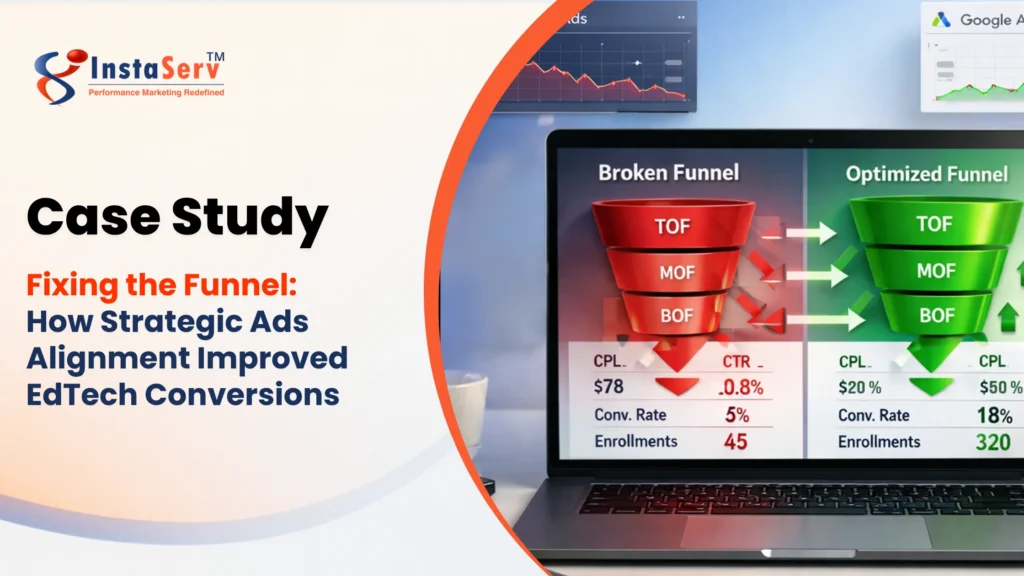
In the EdTech industry, generating leads is only valuable when those leads convert into real enrollments. For many education brands, paid advertising can quickly become inefficient when targeting, messaging, and tracking systems are not aligned.
This case study explores how InstaServ conducted a strategic evaluation of a growing EdTech brand in Australia that was generating leads through Google and Meta Ads but struggling with low qualification rates, generic creative messaging, and fragmented data systems.
The objective was clear: improve lead quality, strengthen positioning, and build a scalable marketing foundation.
The client is an online EdTech platform offering personalized academic support for middle and senior secondary students. They focus on core subjects like Mathematics and Science with a strong emphasis on advanced curriculum preparation. Their goal is to drive qualified enrollments and improve lead quality through digital marketing efforts.
During the meeting, it became clear that the client’s campaigns were generating leads, but most weren’t converting. Here’s what we found:
The most pressing issue was the lead qualification rate.
Although leads were being generated consistently, fewer than 30% were qualified. This meant that the majority of inquiries were either not aligned with the service offering or not serious prospects.
The impact was significant:
Lead volume existed – but conversion efficiency did not.
Google Ads was generating a high volume of leads, but many were not qualified.
Analysis revealed misalignment between leads and campaign focus:
Despite this, the budget and creative messaging weren’t aligned with actual performance.
The ads across Google and Facebook lacked distinction. As the client said:
“Nothing is there; it’s just like a generic company. Why would he come to me?”
Specific issues included:
Parents evaluating tutoring services were not given a strong reason to choose this provider over alternatives.
Without distinct positioning, ad engagement and conversion potential were constrained.
Operational inefficiencies further complicated performance optimization.
Without a centralized data infrastructure, performance insights were fragmented, and decision-making lacked depth.
At the time of review, Meta Ad campaigns were still in the early testing phase and had generated only five leads.
After reviewing the campaigns and discussing everything in the meeting, we realized this wasn’t about small tweaks. The structure needed refinement.
So we focused on three core areas: lead quality, strategic clarity, and scalable systems.
In the meeting, we aligned on one key point – lead volume alone doesn’t drive growth. Qualified leads do.
So we shifted performance tracking toward:
Now, campaign success is measured by business impact, not just form submissions.
Data showed that nearly 60% of leads were coming from Western Australia.
Instead of distributing the budget evenly, we decided to:
This ensures smarter and more efficient ad spend.
We identified that 80–85% of qualified leads were from the Indian audience.
Rather than ignoring this, we refined targeting to:
This brought clarity to who we are primarily speaking to and improved targeting efficiency.
We also agreed that the creatives needed stronger differentiation.
So we moved toward:
The focus is now on emotional connection and clear differentiation in a competitive EdTech market.
Since lead tracking was being managed manually, we proposed implementing a centralized CRM system such as HubSpot or Zoho.
This allows us to:
Strong analytics and data tracking systems support sustainable growth.
Finally, we established a more structured optimization process.
We now:
Campaign management has shifted from reactive to systematic and proactive.
Once we made these changes, the biggest shift wasn’t just in the campaigns – it was in the way we started looking at performance.
Earlier, the focus was on how many leads we were getting. Now, the focus is on how many of those leads are actually qualified and moving closer to enrollment.
We started seeing:
The funnel feels more controlled now – not just active.
Your business is generating inquiries but struggles to turn them into paying customers. InstaServ is here to help by refining ad targeting, messaging, and precise tracking systems. We help businesses turn leads into paying customers.
Connect with our team and see how smarter lead generation services can improve your marketing results.

CUSTOM
Services:
SME
Services:
STARTUP PLAN
Services: